
Uses and potential side effects of the herbal product Moringa oleifera as a food supplement and herbal medicine
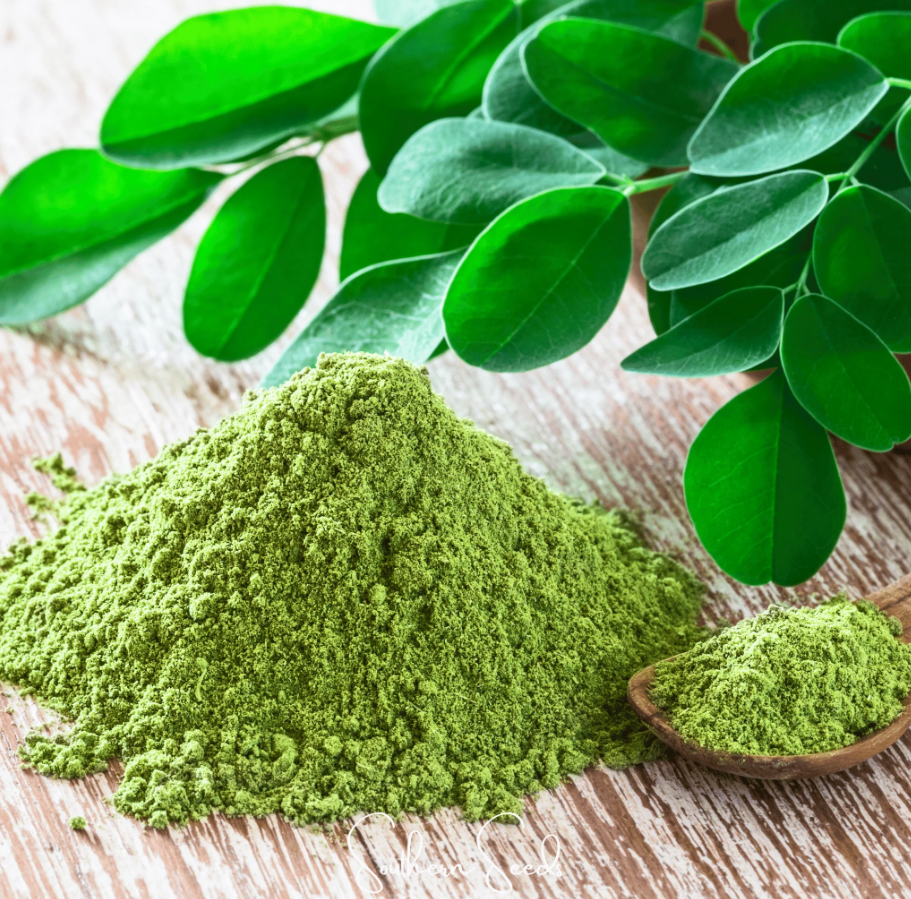
Over the past few years there has been a growing trend and widespread resurgence of alternative herb-based supplements as part of a healthier lifestyle, aided through social media. This shift reflects an ever-growing awareness of the natural benefits that plants and herbs may offer. Although this knowledge has been used since ancient times and the pharmaceutical industry has been utilising this for decades, the increased use of herb and plant-based food supplements is shifting to a prophylactic measure rather than a replacement to modern medicine.
Amongst these, Moringa Oleifera stands out as a herb that may be used as both a food supplement due to its high nutritional properties and its medicinal properties. Known as a “superfood” it has been with us for centuries, known better as “miracle tree”. All the components of this plant in a wide range applications, from malnutrition to supporting immune health.
As the demand for sustainable and natural remedies increases, Moringa Oleifera exemplifies the potential of integrating contemporary wellness practices to our modern lifestyles.
Introduction
I based this research on two herbal products, each having the main component as Moringa oleifera, however one product was in a powder form and the other as tablet. This was done to differentiate the difference between the two variants involved as well as the different parts of the herb utilised in the delivery of the product. I will focus on the tablet as this clearly states the product as a food supplement and the extracts utilised.
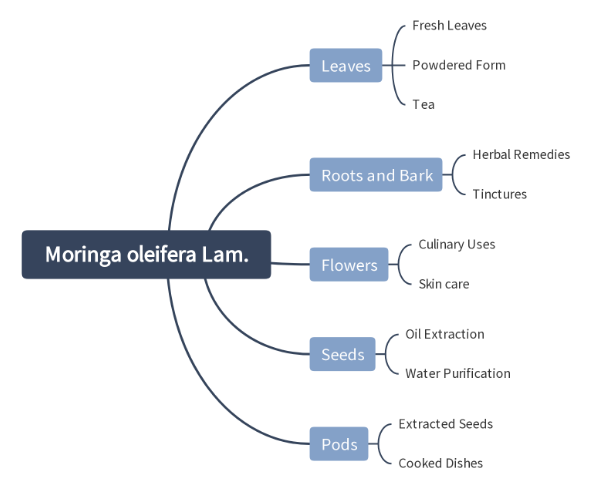
Moringa oleifera which forms part of the Moringaceae, Moringa oleifera Lam., more commonly known as munga and is also referred to as “miracle tree” or “tree of life”. It is a drought resistant and relatively fast-growing tree native to India. It has been used for centuries and is part of the Ayurveda due to its medicinal properties and complex nutritional content. Most components of this plant are used both in culinary, pharmaceutical and industrial applications.
Although technically a tree and has a botanical classification of one, it is still considered as a “herb” because the leaves, seeds, flowers and other parts are used in traditional medicine, it is commonly referred to as medicinal herb. Even within culinary usage, the leaves are often dried or ground similar to other herbs like basil and mint.
Originating in the Northwest of India, ancient Ayurvedic texts list over 300 ailments that this herb is able to treat from skin disease to digestive disorders. It spread through Egypt, Greece and Rome by the 19th century it expanded throughout most of the Southern hemisphere due to its adaptability to different temperamental climates and soils.
There are 13 species within the Moringa genus and although all are used for either medicinal or for better yields in certain areas / countries, the M. Oleifera is still the predominant species with strain variations for better growth, terroir conditions or yields. Examples of the latter are the PKM-1 and PKM-2 strains which provide more leaves, thus more leaf powder.
Plant properties
The Taxonomic classification for this herb is the following:
| Kingdom | Plantae |
| Subkingdom | Tracheobionta |
| Super division | Spermatophyta |
| Division | Magnoliophyta |
| Class | Magnoliopsida |
| Subclass | Dilleniidae |
| Order | Capparales |
| Family | Moringaceae |
| Genus | Moringa |
| Species | oleifera |
This plant contains various essential amino acids, Antixodants, vitamins and flavonoids that are beneficial for consumption. The following depicts the chemical compounds present in the Moringa oleifera
| beta-Bisabolene | Isopropyl isothiocyanate | trans-2,cis-6-Nonadienal | Sabinene |
| Octanal | Hexanal | 9-Octadecen-1-ol, (9Z)- | ar-Turmerone |
| Pinocarvone | 2-Methyl-1-butanol | 4-Carvomenthenol | Nerol |
| 1-Butanol | Phenylacetonitrile | (1R)-2-methyl-5-propan-2ylbicyclo[3.1.0]hex-2-ene | 2-Furanmethanol, 5ethenyltetrahydro- alpha,alpha,5-trimethyl-, cis- |
| 1-Hexadecanol | Decanal | 2-Hexenal | (Z)-p-Menth-2-en-1-ol |
| Decanoic acid | Furfural | cis-3-Hexen-1-ol | (E,Z)-2,4-Decadienal |
| Myrcene | Perillene | alpha-Terpinene | alpha-Phellandrene |
| Nonana | 1-Tetradecanol | Neryl acetate | Camphene |
| 2-Heptenal | Heptanal | 2-Hexen-1-OL | 2-Cyclohexen-1-ol, 3methyl-6-(1-methylethyl), (1R,6S)-rel- |
| 2-Nonenal | Dodecanal | Anethole | D-Glucose |
Main uses for the Moringa Plant:
Product ingredients and nutritional values
Listed specifically as a food supplement, the Moringa tablet provides detailed information on the ingredients as somewhat limited nutritional details. The latter listing only Moringa dry extract (1g extract). However, the ingredients are more of interest. Amongst the other ingredients (Bulking agent, Microcrystalline cellulose, Sorbitol, Magnesium stearate and coating agents), there is clearly indicated that the herbal product is from Moringa oleifera but the ingredients here are listed as follows:
- Moringa oleifera Lam., semen – dry extract E/D:1/4
- Moringa oleifera Lam., semen – dry extract tit. 0.2% alkaloids
There is no notion of exact dosage or percentage per each ingredient however from the information provided we may determine that the extract comes from the seeds and that the dry extract i.e. the method of removing water content from the seed making more it potent. This is from the E/D:1/4 value which relates to the extraction to dilution ratios thus being 1 part extract to 4 parts diluent. The 2nd ingredient lists the similar component for the tit referring to the titration or concentration of the solution, of which there is 0.2% alkaloids. The latter potentially, although not specific could be inferring to moringinine and spirachin which possess beneficial properties but are toxic in higher doses, thus the very small dose.
A quick summary to list the product in raw powder which is more served as a tea/smoothie or juice as has only 1 ingredient listed, 100% Moringa oleifera organic powder from India or Africa. The nutritional indication here per 100g show high levels of Carbohydrates (55.2g), Fibre (26.9g) and Protein (19.7g) following Fat content (9.7g). There is however Calcium (185mg), Phosphorus (112mg), Iron (4mg), Potassium (337mg) and Magnesium (147mg). The total energy is listed at 386kcal.
Uses and Extraction
Within our food supplement we have “Moringa oleifera Lam., semen – dry extract E/D:1/4” and “Moringa oleifera Lam., semen – dry extract tit. 0.2% alkaloids“. These list the details on the part of the plant, the method the component is taken and the Drug ratio. Each of which has a number of stages until the final product is attained.
Raw material collection
The “semen” part indicates that this part of the food supplement comes from is the Seed. When mature seeds are harvested from the plant, they are initially dried and cleaned to remove impurities, such as debris, damaged or moulded seeds and husks.
Extraction
The extract or rather dry extract is a method by which the raw material is converted into a concentrated powder or fine granules. This is obtained by removing any solvent from the liquid extract. Firstly, the seeds are crushed or ground into a fine powder to increase the surface area of extraction. Then the appropriate solvent must be selected, and the more common options are either water, ethanol or a mixture of both. This depends on resulting active compounds that we would like to keep.
In this scenario a mixture would be mostly likely to be used as on the Patient information leaflet (PIL) there is highlighted that the compound is rich in Vitamin C, beta-carotene, chlorogenic acid and antioxidants which may be extracted by water. There is also quercetin, flavonoids, lipid and fat-soluble antioxidants which are better extracted through ethanol.
A ratio of the solvent vs powder would also be assigned, which in this case shows 1 part material with 4 parts of the solvent and there would be various method for the mixture to occur. The most common are Cold maceration, percolation or reflux extraction. Cold maceration is a process by which the powder is mixed with the solvent and left to soak for a predetermined time at room temperature. This is to preserve any heat-sensitive compounds. On the other hand, reflux extraction is the process of heating the solvent that is mixed with the powder, agitating the mixture and therefore extract compounds more thoroughly. Lastly there is percolation which is a slow process that is constantly filtering the powder through the solvent so the have more concentrated extraction.
The resulting mixture or extract is then filtered so that insoluble materials are removing, thus results in a pure liquid extract containing only the seeds’ bioactive components (BAC)
Drying
In several extraction method this stage is split into two phases. The liquid extract is first put under what is called as reduced pressure or vacuum evaporation. A process by which a vacuum is created or pressure is reduced by lowering the boiling point of the solvent, thus evaporating the majority of the solvent, resulting in a semi-dry extract. This is then further dried by either freeze drying the extract, that is freezing the extract and therefore sublimating the solvent or else spray drying which occurs by putting the semi-dry extract into a hot drying chamber, evaporating the remaining solvent.
Standardisation
The term tit refers to titrated which means that the extract has been standardised to contain specifically 0.2% alkaloids by weight. These alkaloids known for their medicinal properties must be at a specific rate as these could lead to several implications, such as side effects, risk or efficacy.
The concentrated extract (after it is vacuum evaporated or reduced pressure evaporated) is analysed using titration or through High Performance Liquid Chromatography (HPLC) to determine the level of alkaloids present and their density. If the concentrations values do not match the 0.2% then concentrating further or diluting occurs to arrive to the precise value of 0.2%. Dilution normally occurs by adding an inert carrier, in this case microcrystalline cellulose, which is present as part of the ingredients.
Warnings and side effects
The food supplement provides only a standard warning:
“Keep out of reach of children under 3 years of age. Do not exceed the recommended daily dose. Dietary supplements cannot replace a varied diet and should be combined with a healthy balanced lifestyle. Seek medical advice during pregnancy, breastfeeding and childhood”
It does not provide any potential side effects or other contraindications. Undoubtedly, the specific ratio of alkaloids would also influence the product effectiveness and the safety risks. If unchecked this concentration may increase the risk of side effects such as digestive problems like vomiting, diarrhoea, nausea of general abdominal pain. There would be more strict medical procedures and supervision of who should take the supplement and under which conditions. Certain alkaloids are toxic in nature and taking in unsupervised or high amounts may cause irreversible affects.
Consistency would also have a diverse effect, as each batch of seeds may produce different levels of alkaloids. The same would apply to standards, regulatory guidelines and overall trust in the product itself.
Conclusion
Moringa Oleifera stands out as a perfect example of a medicinal herb that bridges the gap between traditional herbal remedies and modern superfoods. By understanding its origins, applications, benefits, and limitations, we can better appreciate it makes a vital resource for health and sustainability.
The standardised ingredient shows the importance and precision in creating safe and effective supplements. Techniques like vacuum evaporation and titration ensure the preservation and balance of active compounds, optimising benefits while minimising risks.