
Ficus carica pollination and the significance of fig wasps vis-à-vis pollination of the different species of fig trees worldwide
The Ficus genus belongs to the Moraceae family, which incorporates more than 800 species that are distributed throughout the world. Predominantly in the tropical and subtropical regions, Asia, Africa, Australia, Eastern and South Eastern parts of the Mediterranean and a number of areas in America.
The Ficus genus has reached a mutualistic symbiotic relationship that has survived through thousands of years and although it can be found throughout the world it still keeps this relationship active with the Agaonidae wasp. The latter is a highly specialised and evolved wasp that its sole short life cycle completely revolves around the Ficus plant trees.
We are used to the fig fruit as a highly sweet delight that is used in several recipes across different cultures, without considering how the fruit comes about nor the intrinsic process it goes through. Nowadays we do have Parthenocarpy Ficus carica which is commonly used as our main sweet fruit source and is mass produced throughout the world, making it a highly sought after and high economic valued tree. Nevertheless, there are still several Calimyrna varieties that offer this complex, yet beautiful relationship. An interesting point to put forward is that the fig fruit is actually an inverted flower, also known as a syconium
In this document I shall focus on the pollination of the Ficus carica and the relationship with its wasp Blastophaga psenes. I will also discuss the significance of pollination and factors that affect the fig tree worldwide
Ficus carica – Pollination
The Ficus carica also known as the common fig tree provides a remarkable relationship with Blastophaga psenes, a fig wasp that is exclusively used to pollinate this tree. Its process of pollination is unique and complex. This obligate mutualism involves an intense coevolution of both species, whereas the tree completely relies on the fig wasp for pollination, while the wasp requires the fig to lay the eggs and feed the larvae.
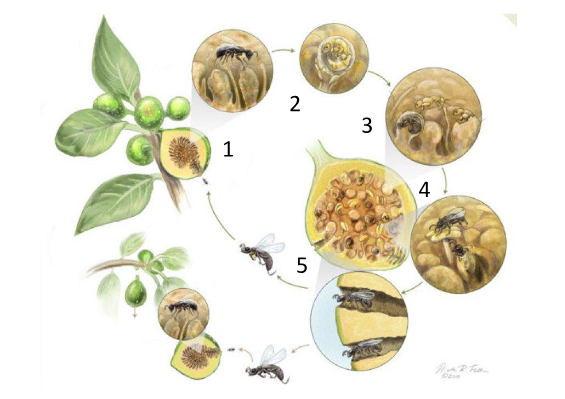
The diagram and steps below show how the pollination and wasp life cycle occur concurrently.
The pollination process commences where a female fig wasp carries pollen land of a fig fruit. The latter releases species specific chemicals to grab the attention of the nearby wasps. The fig fruit has a very small opening called an ostiole and this is the location from which the pollen full female wasp enters the fig fruit. Her body is specifically adapted to enter the fruit, starting from the wedge-shaped head and squeezes herself between the bracts that guard the opening of the Ostiole. To successfully enter the fig fruit, the wasp loses her wings and most of her antennal flagella which are torn off her body to allow passage into the fig. She uses her front and hind tibia and mandibles to pull herself through the bracts so as to stop herself from slipping backwards.
As soon as she finds herself in the hollow fig cavity, which is aligned with white or rather translucent female flowers. The wasp immediately starts to lay her eggs within the flowers. In doing so she also pollinates the flowers that were stuck onto her. The eggs from the female wasp are injected near the ovule of each flower and also inject a secretion to induce the same ovary to grow and form a gall from which the wasp larva will grow. The fig wasp does not lay eggs in all the ovules, normally only the ones with a shorter style, thus leaving longer style ovules to develop into seeds. This is a specialised feature of the fig fruit that acts as to help the wasp but at the same time prevent it from depositing eggs in all the ovula.
After pollination of egg laying the female fig wasp dies. The larvae grow and they consume the gall. In as little as 30 days, full adult sized wasps eat their way out of the gall. Normally these would be male fig wasps. They will be very different from the female wasps, normally smaller and wingless. The male’s primary role is the fertilise the other female wasps, many of whom will be their sisters, which would normally still be in the neighbouring galls. Fig wasps have a haplodiploid system, meaning that unfertilised eggs would develop into males called haploids and females which are diploid as they would develop from a fertilised egg, having chromosomes from both the mother and the father.
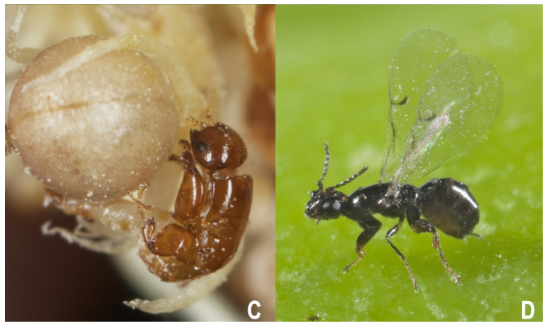
The below are two images of the male and female Blastophaga psenes. (Left – male fig wasp, right – female wasp)
After fertilisation the male wasps performs his second and final role, he starts to borrow through the fig fruit. Most of the male fig wasp dies in this attempt and the ones that borrow through outside are normally eaten by predators. In the meantime, the female fig wasps emerge from the gall and make their way through the channels that the male wasps have just dug up. However, in doing so they cover themselves with pollen and are therefore ready for the whole process to start over again.
Chemicals and evolution pressure
Excluding external factors such as predators, climate change, finding a new host and weather conditions, one of the biggest challenges that most fig wasps find is time.
We have already determined the males have a very short lifespan and only have 2 tasks, that of fertilisation and burrowing through the fig. They cannot travel to another fig fruit as they do not have wings and most male’s species of the Blastophaga have less developed compound eyes. This makes them easy prey for the ones that survive when exiting the fig fruit.
Females on the hand have wings, but they have rather poor flight capabilities, they are quite susceptible to dehydration and must navigate through the forest canopy to find a new compatible host Ficus plant to deposit their eggs. All of this has to be done in their short lifespan of 24-48 hours (depending on the species). This creates distinctive evolutionary pressure. There is a rush to find a host to deposit the eggs. Putting aside that some Ficus fruit are dioecious (although in a minority, one of which is the Ficus carica), the vast majority are monoecious, giving some breathing space to the fig wasp.
Given this short lifespan it does not make sense for the Ficus plant to produce all its fruits within the same time period, like other trees. This term is called synchronous fruiting. For Ficus plants it actually does the opposite, within the same species population, different trees will be at a different stage of development throughout the year and this means that fruiting also happens throughout the year. The asynchronous fruiting ensures that there is always a supply of fig wasps. Although this may seem as an aid to the fig wasps, in reality it is something that occurs for the tree itself as this maintains a constant flow of pollinators that pollinate the trees.
One of the main disadvantages of asynchronous fruiting is to find a suitable fig fruit amongst all those that are not in the development stage. As discussed, female fig wasps are quite poor and are flying, therefore the fig fruit provides another helping hand. It entices the female fig wasp by specific chemicals, known as volatile organic compounds (VOC). Different Ficus trees produce a VOC ratio to guide the female’s fig wasps to the fruit.
The syconium emits VOCs which are highly specialised scents located at the base of the ostiole and the surrounding bracts. This compound acts as a beacon for the female fig wasps. What makes this scent interesting is that although the Ficus tree secrete the same type of chemicals, the ratio is specific to that species. In doing so it captures the scent of the same variety of fig wasps, or at least close relatives. In doing so, the female wasp is guided through the forest, dense foliage as well as the tree’s fig fruits that may within different development stages to the ones that are mature enough to be pollinated.
Challenges
We discussed the evolutionary difficulties for fig wasps to pollinate a Ficus plant but there are other challenges that pose a threat to the pollination and life cycle.
Predators
Other insects such as ants, beetles and spiders pose a threat to both male and female fig wasps. Birds also pose a threat to female fig wasps. The other set of predators are the parasitic ones. Examples are the non-pollinating fig wasps themselves, as well as parasitic wasps such as Sycophafa or Apocrypta that deposit eggs next to or inside the larva that eat them from the inside out.
Weather conditions and climate change
Extreme or freak conditions can cause a huge impact on the fig wasp pollination as well as the Ficus tree itself. Natural disasters, such as heavy rain, winds, drought or fire can reduce the population size dramatically and pose serious threats to the natural ecosystem. Climate change has also an impact. The increase in temperature or imbalance of the eco system can reduce the life span of the female fig wasps (dehydration) and therefore not managing to deposit her eggs. Even worse are man-made changes such as deforestation, fires or urbanisation. The hit on the plant population size as well as the wasps can have a detrimental effect.
Human intervention and influence
Like anything else, human intervention comes at a cost. Pollution is a major concern. Female fig wasps rely on the VOCs and pollutants inhibit the chemical signal thus distorting or blinding the wasps to locate a new host, expiring its short lifespan and in turn keep the fig fruit sterile.
Pesticides and insecticides can also pose a similar effect. However, they may also target the syconium. Such as changing the chemicals or chemical composition inside, making it impossible for the female wasp to deposit her eggs or even the larva to form.
Continental or Ficus tree eco system shifts. When we move Ficus trees from their natural areas and introduce them to new regions for cultivation or propagation we have to think of all the factors that will be affected. Firstly, the obligate symbiosis between tree and wasp, but also the effect it will have on the area that it is being introduced. One point that is also being noticed that whereas we have a one-to-one scenario that is one species of tree to one species of fig wasp (example Ficus carica and Blastophaga psenes), in reality similarly related fig wasps can “pollinate” the same species of tree. Whilst this may be good in a way it still poses a threat as the new non-native Ficus tree is in direct competition with the native variety.
Conclusion
This obligate symbiosis has a long-standing evolution that is studied, explored and considered a wonder within an ecosystem. However, such a specialisation may be seen as a double-edged sword. In itself both the Ficus plant and the fig wasp benefit and rely on each other for their survival and the number of factors that make this work is astonishing, yet very fragile. It gives maximum efficiency when there is a stable, non-altering environment. If one of the steps in this elaborate process is broken, the whole process collapses. Does this mean that it will be an inevitable dead end or a huge vulnerability when there is a rapid change?
As we can see from several points, climate change and human influence can affect this fragile relationship. How fast can evolution adapt to the changes that are set before it?
References
Compton, S.G., et al. (2020). ‘The interaction between figs and fig wasps in a changing world’. Annual Review of Entomology, 65, pp.337-357
Wang, R., et al. (2021). ‘Cryptic species, host switching, and geographic variation in fig wasp mutualisms’. Frontiers in Ecology and Evolution, 9, p.631144.
Magallo, L., et al. (2020). ‘The multi-component floral scent of Ficus species: asymmetry in chemical signals within a mutualism’. Functional Ecology, 34(11), pp.2240-2252.
Online links:
https://www.figboss.com/post/fig-tree-wasp
https://www.youtube.com/watch?v=Bg73x-iwIAY
https://www.youtube.com/watch?v=9DQTjv_u3Vc&t=3s
https://www.youtube.com/watch?v=WRfZf43dnj8
Images: https://www.figweb.org/Fig_wasps/Agaonidae/Agaoninae/Blastophaga/Blastophaga_psenes.htm